
When talking about ion/plasma nitriding, one of the main topics is the white layer. And the most common questions are: What is it? Is it brittle? Is it always desirable?
Let’s explain what the white layer is and answer these questions in a simple way.
What is the white layer?
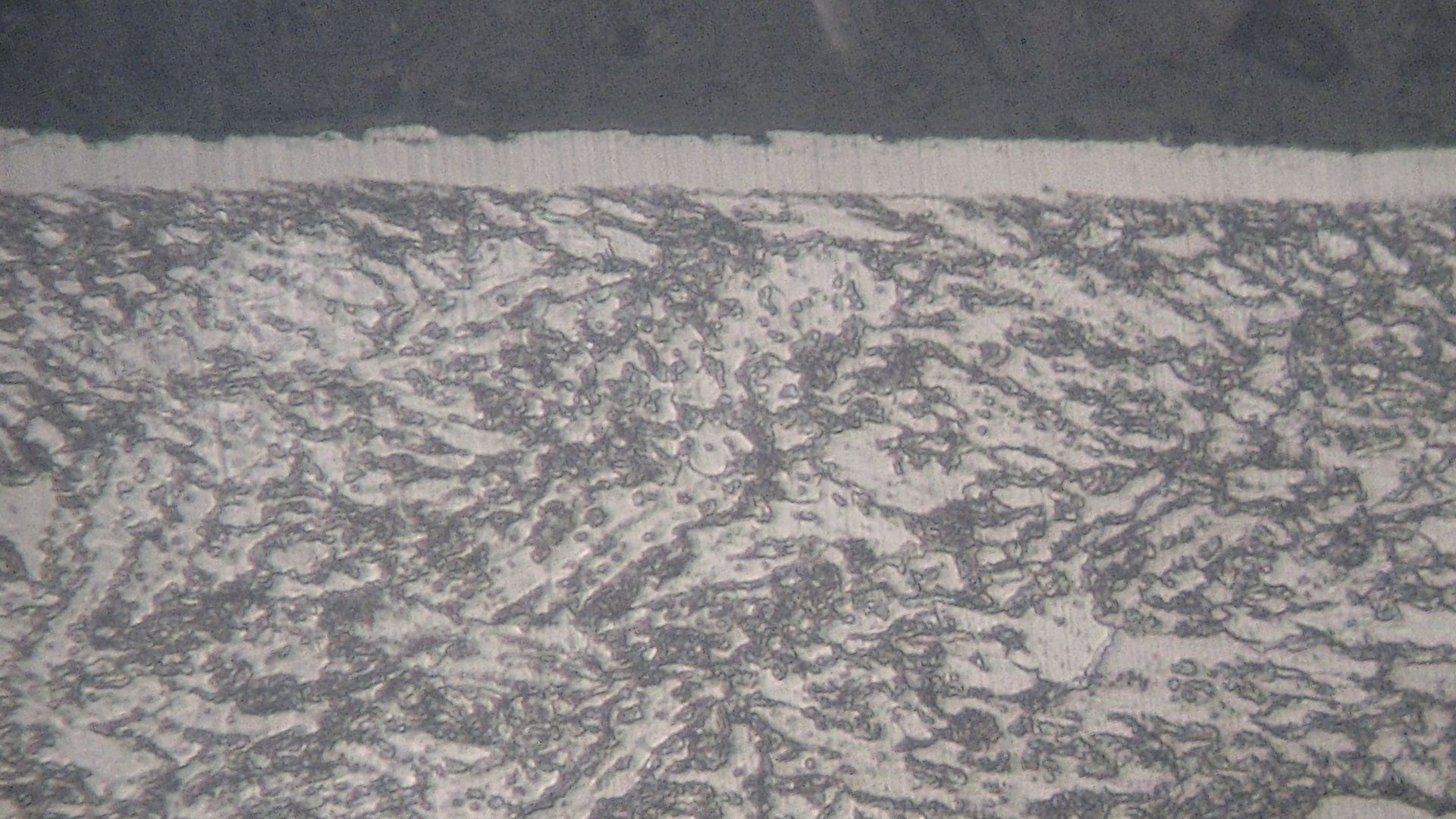 |
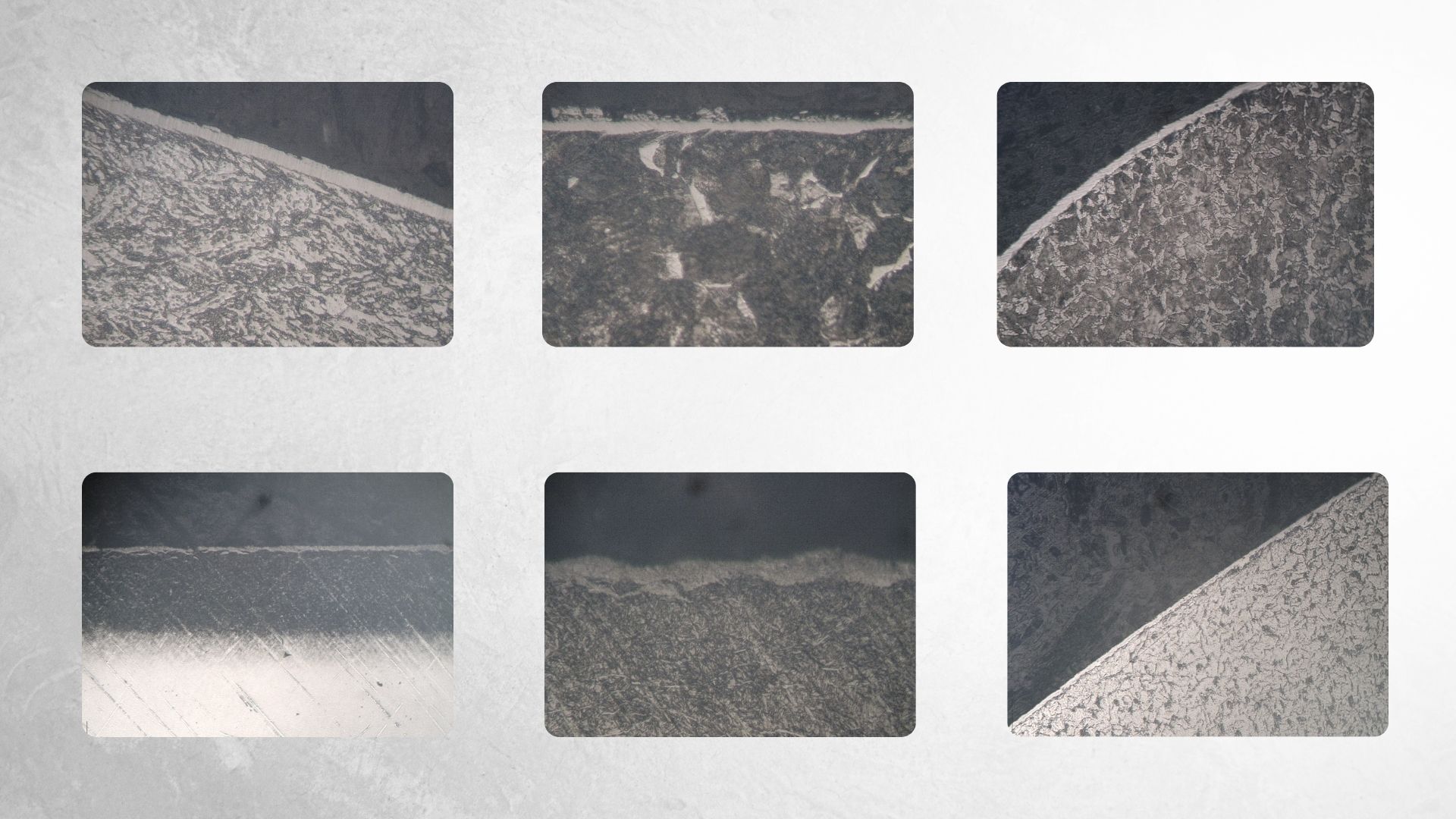 |
| White (Compound) Layer after nitriding | Different White Layers achieved for different steel grades |
After metallographic etching of the cross-section of a nitrided steel, the outermost surface layer often appears white under the microscope, which is why it is called the white layer. The more technical term is compound layer.
In our article on Ion Nitriding Mechanics, we have explained that ions, radicals, and excited neutral species interact with the surface. This helps heat the part, clean and activate the surface, and supply active nitrogen. Nitrogen then diffuses into the steel. When the nitrogen concentration in the first few microns near the surface becomes high enough, it exceeds the solubility of nitrogen in ferrite at the process temperature. At that point, iron-nitrides form at the surface. This is why the layer is called the compound layer.
The Different phases
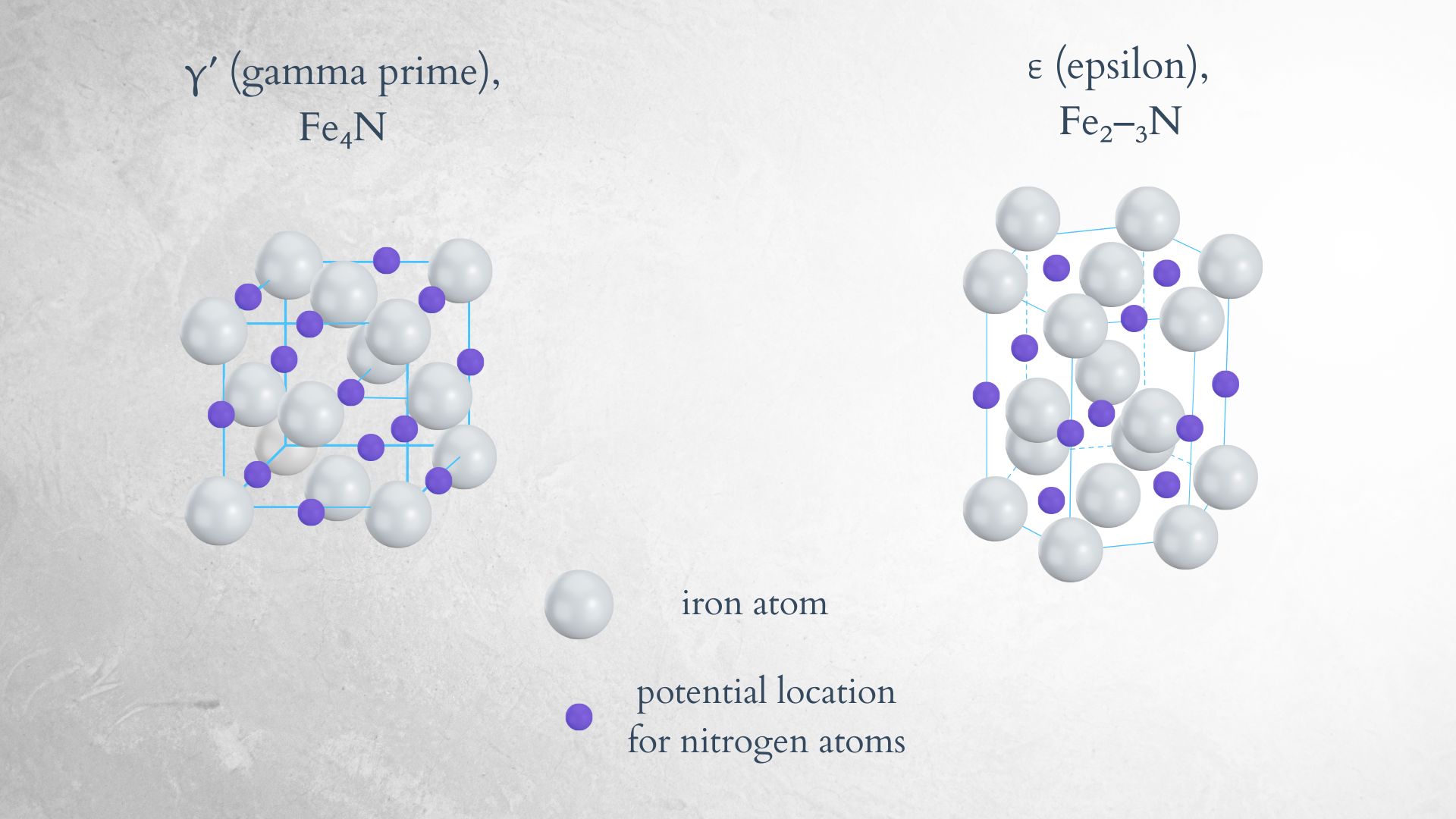
In steel nitriding, the compound layer is mainly made of two iron-nitride phases:
The gamma prime (γ′) phase Fe4N - usually forms at lower to moderate nitrogen potential/activity. It has a cubic crystal structure.
And epsilon (ε) Fe2-3N - This phase forms at higher nitrogen potential/activity. And it has a hexagonal crystal structure.
A commonly observed sequence is that gamma prime forms first, and as the nitrogen activity at the surface increases, epsilon becomes more prominent.
Benefits of the white layer
A compound layer can be very useful because it has high hardness and can improve abrasive and adhesive wear resistance, and, often, corrosion resistance.
However, not every part needs the same nitrided structure. For components such as dies, molds, and some hydraulic parts, a controlled compound layer, often rich in epsilon iron nitride, can be beneficial.
While, for parts exposed to high contact stress or fatigue loading, such as gears and shafts, the compound layer is usually kept very thin and dense, or sometimes avoided altogether.
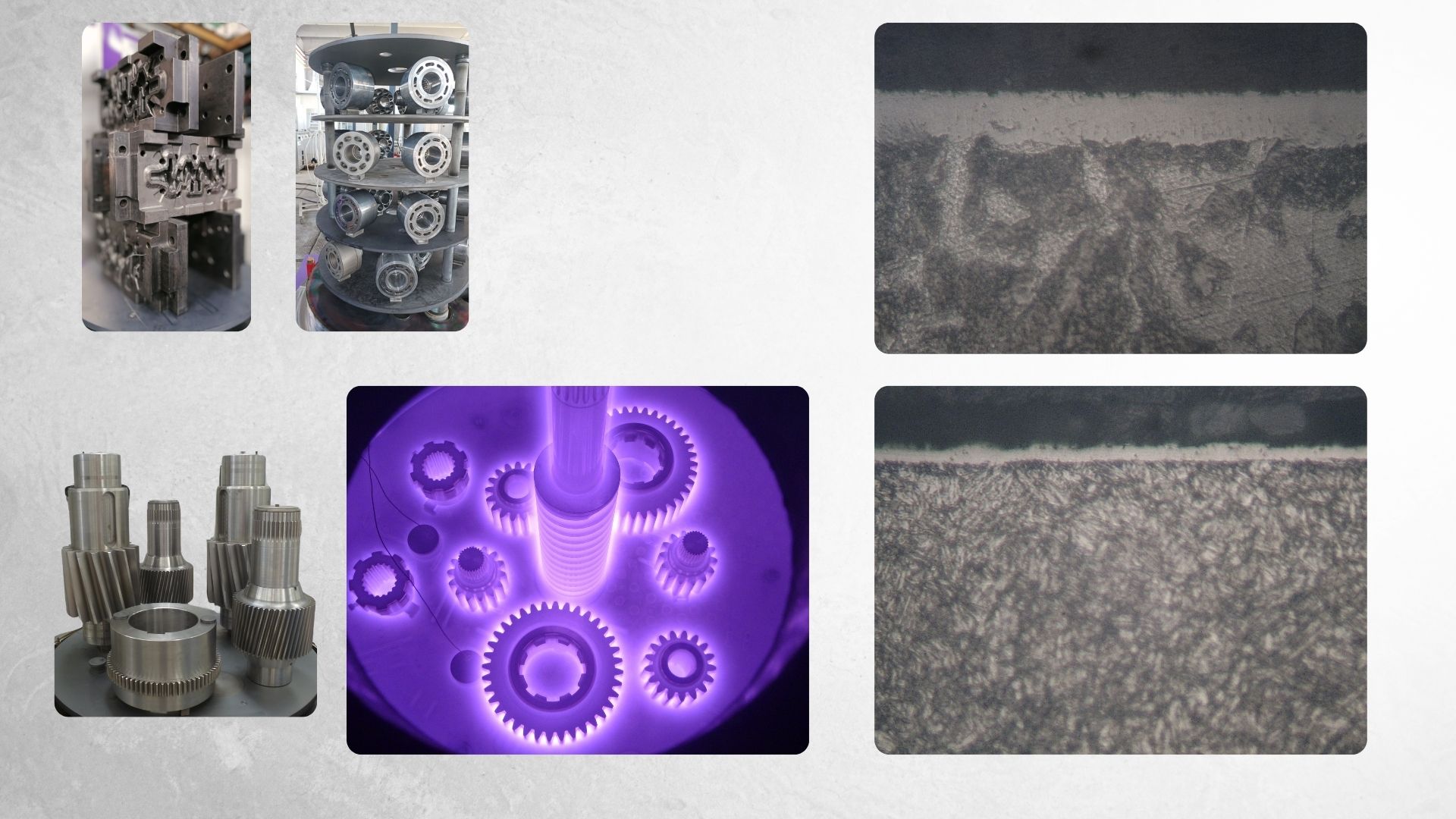
One of the main advantages of ion nitriding is that the formation of the white layer can be controlled with relatively high precision. By adjusting the process parameters and considering the steel grade, it is possible to obtain a high-quality compound layer that is predominantly gamma prime, predominantly epsilon, a mixture of both, minimal or no compound layer at all, depending on the part requirements.
Be sure to check our video for a visual explanation:
 RU
RU  BG
BG  ES
ES  EN
EN